
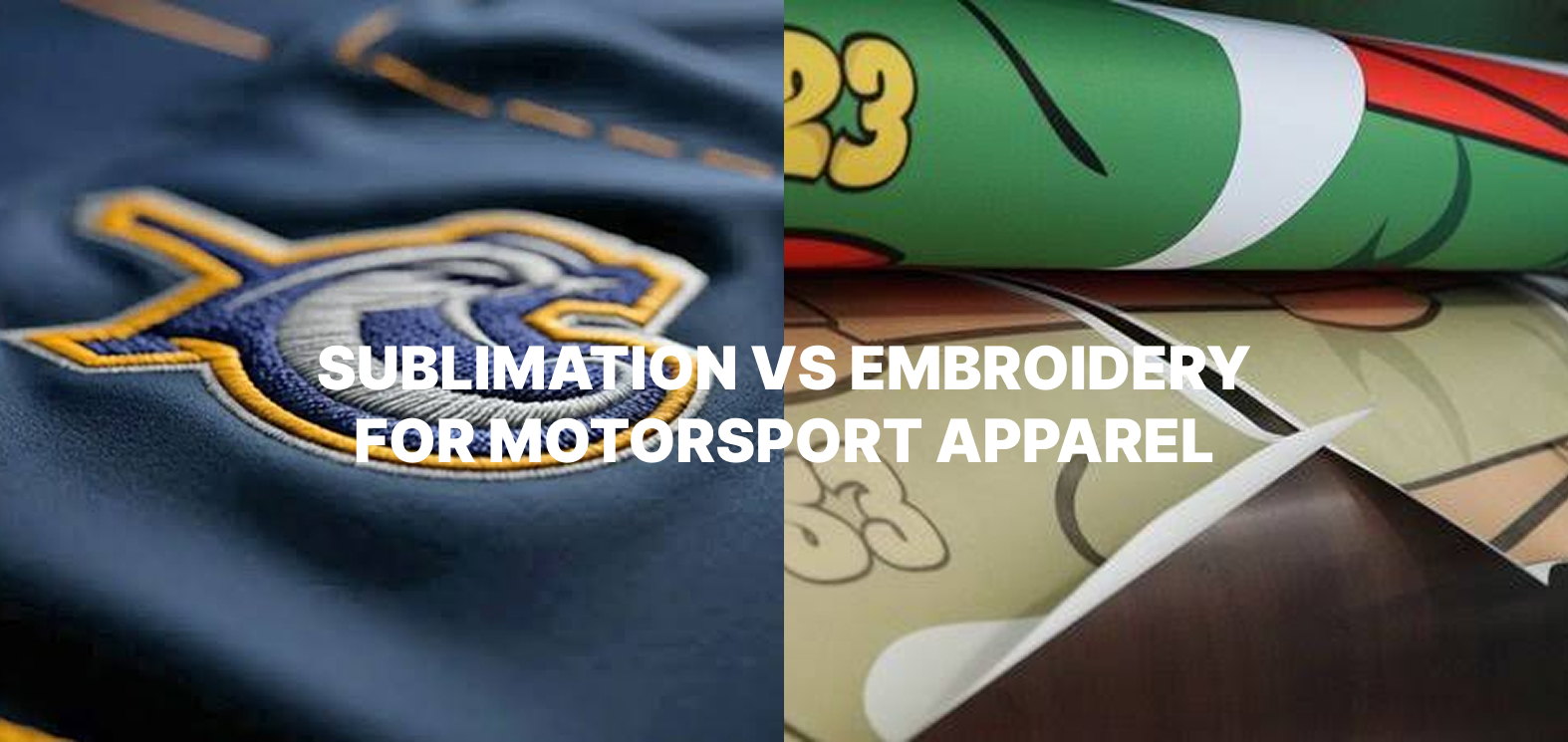
Sublimation vs Embroidery for Motorsport Apparel — Which Is Right for Your Racing Kit?

Every piece of custom racing gear starts with the same decision: how does the design get onto the material? For Canadian motorsport teams ordering race suits, crew shirts, karting suits, canopies, and trailer curtains, two methods dominate: dye sublimation and embroidery. They look different, feel different, cost differently, and are suitable in different applications.
This guide explains what each method actually does, how they perform in a racing environment, and which is the right choice for each type of gear in a typical Canadian race team’s kit.
What Is Dye Sublimation?
Dye sublimation is a printing process where heat converts ink from a solid into a gas, which then bonds directly into the fibres of a polyester material. Because the ink becomes part of the fabric rather than sitting on top of it, the resulting design has no texture, no added layer, and no surface that can peel or crack.
In practice, this means a sublimated racing suit, crew shirt, or canopy panel carries its design permanently — the graphic is as durable as the fabric itself. You can wash it repeatedly, expose it to heat and sun, and the design remains unchanged.
What sublimation requires
Sublimation requires a polyester or high-polyester-blend fabric to work. The ink molecules bond with polyester fibres at the chemical level — on cotton or natural fibres, the bonding does not occur and the design fades quickly. We are now able to offer sublimation on SFI 3.2a/5 and SFI 3.4 rated suits.
What sublimation delivers
Full-colour coverage across the entire surface of the garment or panel. Gradients, photographic images, complex multi-colour graphics, sponsor logos with fine detail — sublimation handles all of it without any restriction on number of colours or design complexity. There is no per-colour cost increase. A design using two colours costs the same to produce as a design using twenty.
The finish is smooth and lightweight. The garment breathes and moves exactly as the base fabric was designed to.
What Is Embroidery?
Embroidery is a decoration process where thread is stitched directly into the fabric surface using a programmable machine. The thread builds up a design in raised, textured stitching that is visible and tactile on the surface of the garment.
Embroidery is a well-established decoration method with a long history in team apparel — it is the technique used for team crests on club polo shirts, sponsor logos on jackets, and name patches on uniforms across virtually every team sport.
What embroidery requires
Embroidery works across a wide range of fabrics — cotton, polyester blends, nylon, and heavier materials all accept embroidery well. The technique involves stitching into the fabric surface rather than bonding with it, so fabric type is less of a constraint.
The design must be digitized — converted from a graphic file into a stitch file that tells the machine how to construct the design in thread. Digitizing introduces constraints: fine lines, small text, and complex gradients are difficult to reproduce cleanly in thread. Embroidery is best suited to bold, structured designs with defined areas of colour.
What embroidery delivers
A premium, tactile finish. Embroidered designs have a three-dimensional quality — the stitching sits above the fabric surface, catches light differently than the background, and communicates a level of craftsmanship that sublimation printing does not replicate. On a polo shirt collar or a team jacket chest, embroidery signals quality and permanence in a way that resonates with sponsors and officials.
Embroidery is also highly durable on the right garment. Thread does not fade the way printed inks can fade in harsh conditions. On heavy-duty fabrics like nylon outerwear or cotton polos, an embroidered logo will outlast the garment itself.
Side-by-Side Comparison for Motorsport Applications
| Dye Sublimation | Embroidery | |
|---|---|---|
| Colour range | Unlimited — full photographic colour | Limited to thread colours — gradients are difficult |
| Design complexity | No limit — fine detail, gradients, full-coverage | Best for bold, structured designs |
| Texture | Smooth, no added surface | Raised, tactile stitching |
| Weight added | None / light layer on SFI suits | Slight — increases with design size |
| Breathability | Unchanged | Slightly reduced in densely stitched areas |
| Durability | Permanent — design life equals fabric life | Very high — thread does not fade |
| Fabric requirement | Polyester only | Most fabrics |
Which Method for Which Gear?
Race Suits
Every SFI and FIA-rated racing suit is made from Nomex or aramid fibre blends. These materials are fire-resistant and certified to the standards that govern driver safety equipment.
Sublimation on a Nomex-blend suit works because the outer layer of the suit uses a sublimation-receptive polyester shell over the fire-resistant inner layers. The design goes onto the outer shell through the sublimation process, while the structural fire-resistant properties of the suit underneath are unaffected.
For custom SFI racing suits — whether SFI 3.2A/1, SFI 3.2A/5, SFI 3.4 NASCAR, or FIA 8856-2018 — sublimation is the newest method for applying a full custom design.
SFI 3.2a/5 – 2 Layer FR Cotton Custom Suit
Introducing our Traditional FR Cotton Custom Suit, meticulously designed to meet the rigorous demands of auto racing while prioritizing safety, comfort, and performance. This suit features a durable Proban® cotton outer shell, offering exceptional flame resistance and protection on the track.
Karting suits — Sublimated & Embroidered options
Karting suits are made from Cordura, nylon, and abrasion-resistant polyester materials rather than Nomex — they are built for abrasion resistance, not fire resistance. This means they can accept both sublimation and embroidery.
For a fully custom karting suit with your team colours, gradients, and sponsor logos across the entire suit surface, sublimation is a great choice. The same design flexibility that makes sublimation the standard for race suits applies equally to karting suits — unlimited colour, full-surface graphics, no restrictions on complexity.
For a simpler or more traditional approach embroidery is a great option.
EPIC Racewear produces sublimated karting suits for drivers who want full custom design coverage, and embroidered karting suits for drivers who prefer a traditional, structured look.
Crew shirts — sublimation for full design, embroidery for polo-style
Custom crew shirts in motorsport come in two broad categories: performance polyester shirts designed for active pit crew use, and polo-style shirts used for hospitality, sponsor meetings, and formal team presentations.
For performance crew shirts — lightweight polyester with moisture-wicking properties — sublimation is the right method. Full sponsor logo coverage, team colours across the entire shirt, and a lightweight finish that holds up through a long race day are all characteristics that sublimation delivers and embroidery cannot match on a polyester performance fabric.
For polo-style shirts — heavier cotton or cotton-poly blends used for sponsor hospitality and formal team wear — embroidery is the preferred method for logos and team crests. The raised, structured appearance of embroidery suits the more formal context of a polo shirt, and the heavier fabric accepts thread better than lightweight performance polyester.
EPIC’s custom crew shirts are produced primarily using sublimation on performance polyester — the right choice for teams whose crew shirts are worn during active race operations with sponsors watching from the pitlane.
Canopies and trailer curtains — sublimation
Custom racing canopies and trailer curtains are large-format printed structures. The fabric used in canopy tops, valance panels, and trailer curtain panels is a high-denier polyester designed for outdoor use. Embroidery is not practical at this scale — the stitch count required to cover a 10×10 canopy top would be prohibitive in both cost and production time, and the result would be structurally compromised.
Dye sublimation is the standard for all large-format motorsport branding pieces. It produces sharp, UV-stable graphics at any scale, handles the full surface area of a canopy or curtain, and the result is washable, weatherproof, and permanent.
Gloves and shoes —
SFI 3.3/5 racing gloves and racing shoes are built with approved materials, and are either decorated with a screen print process or with transfer logos and embroidery.
Similarly, karting gloves and karting shoes can be built the same way, or can use sublimation.
Frequently Asked Questions
Can you use embroidery on a karting suit? Yes, embroidery can be applied to karting suits. Karting suits are made from Cordura and polyester abrasion-resistant materials and they accept both sublimation and embroidery. For a fully custom design across the entire suit, sublimation is the more detail oriented choice. EPIC Racewear produces both sublimated and embroidered karting suits.
Does sublimation fade on racing gear? No. Sublimation bonds the ink permanently into the fabric fibres — the design does not sit on top of the material and cannot peel, crack, or fade. The design lasts as long as the fabric itself. This is why sublimation is the standard decoration method across performance motorsport apparel.
Why are racing canopies and trailer curtains sublimated and not embroidered? Scale and practicality. Canopy tops and trailer curtain panels are large-format printed surfaces — a 10×10 canopy top has 100 square feet of printable area. Embroidery at that scale is not feasible in cost or production time. Sublimation handles any scale of polyester panel at the same cost per square foot, producing sharp, UV-stable graphics that are weatherproof and permanent.
Which method is more expensive for motorsport apparel? The cost comparison depends on design complexity. For simple designs with one or two colours and no gradients, embroidery and sublimation are broadly comparable. For complex designs with many colours, gradients, or full-coverage graphics — which describes most custom racing kit — sublimation is more cost-effective because there is no per-colour cost increase.